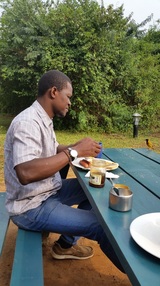
Enjoying a delicious Ugandan meal on my first day back in Murchison Falls National Park.
Settling into my first night back in Murchison Falls National Park (MFNP) following a 5-month absence I have pitched my tent under the expansive shade of a sausage tree right in the heart of this incredible national park. January is a very peaceful time to camp under this tree because sausage trees do not fruit during this time of year. If I elected to camp under this same tree during the fruiting season, I would be a very foolish man indeed. You see, sausage tree fruit is a favorite of elephants and when in-season, scores of elephants will travel from sausage tree to sausage tree gobbling up every bit of fruit that they can find. But for now, I can fall asleep in the peaceful quite of an African evening with the understanding that my tent will not be trampled by a herd of elephants on this night.
As I set my head down on terra firma my eyelids are heavy with the physical weight of a long day’s work and my mind is clouded with the emotional weight of being back in a place that I so love and because I love it so much (for that very reason) I have been separated from it for over 5 months. I have spent these past 5 months pursuing my graduate degree in the RECaP Laboratory at Michigan State University (MSU). In this way I have left my home so that I can ultimately stay at home. I am working to gain the necessary academic credentials to ensure that I can have a long and productive career studying wildlife conservation in East Africa. Despite these relative weights upon my eyes and mind, sleep does not immediately come. I am unsettled. In the last 5 months, snaring in MFNP has been steadily climbing. I am concerned about this pattern. I am concerned about the negative effects on the wildlife in this park if snaring continues to rise. To put it plainly, I am concerned that my ‘Snares to Wares’ initiative may have suffered during my 5-month absence abroad.
Earlier today I traced the youth group involved in the Snares to Wares initiative. Today I was looking for the ‘Craft Boys’. These are boys and young men that were once part of the illegal snaring of wildlife in the park. They did not participate in poaching because they were keen to kill wildlife. They were recruited into this activity at highly impressionable ages, when their access to other opportunities was minimal. Via the Snares to Wares initiative I have helped, in my own way, to convert Lost Boys into ‘Craft Boys’, making toys and goods which they can sell for a profit in the market from the wire snares which defined their previous occupations.
In tracking down the Craft Boys I wanted to know if the Snares to Wares initiative is still functional and to talk about how these young men now experiencing their lives having left poaching behind. My first interaction with the Craft Boys was facilitated by a traditional East African music group that taught me how to play the African harp. This traditional music group plays regularly at the MFNP northern bank ferry landing to entertain visitors as they wait the hourly ferry crossing. Tips and other handouts from visitors are used to fund band member’s joint development projects offering a risk-free legal mechanism to cater for the livelihoods of their relatives who reside in the villages around the park. This is but one mechanism to promote community-based conservation. The Snare to Wares initiative is another such effort. One band member is a close relative of the group leader of the Craft Boys.
Thus, to find the Craft Boys, I first had to find the band. And that, as you might expect, was relatively easy. Follow the beautiful sound of traditional East African music floating across the air. While following this melody, my 4x4 was temporarily detained by some determined-looking baboons. What became rather obvious was that the alpha male was far too preoccupied with a sexually-receptive female to get off the road and let us pass. The alpha male gave us an incredulous glare demonstrating that his mind was on another matter entirely. After a couple of minutes we were on our way.
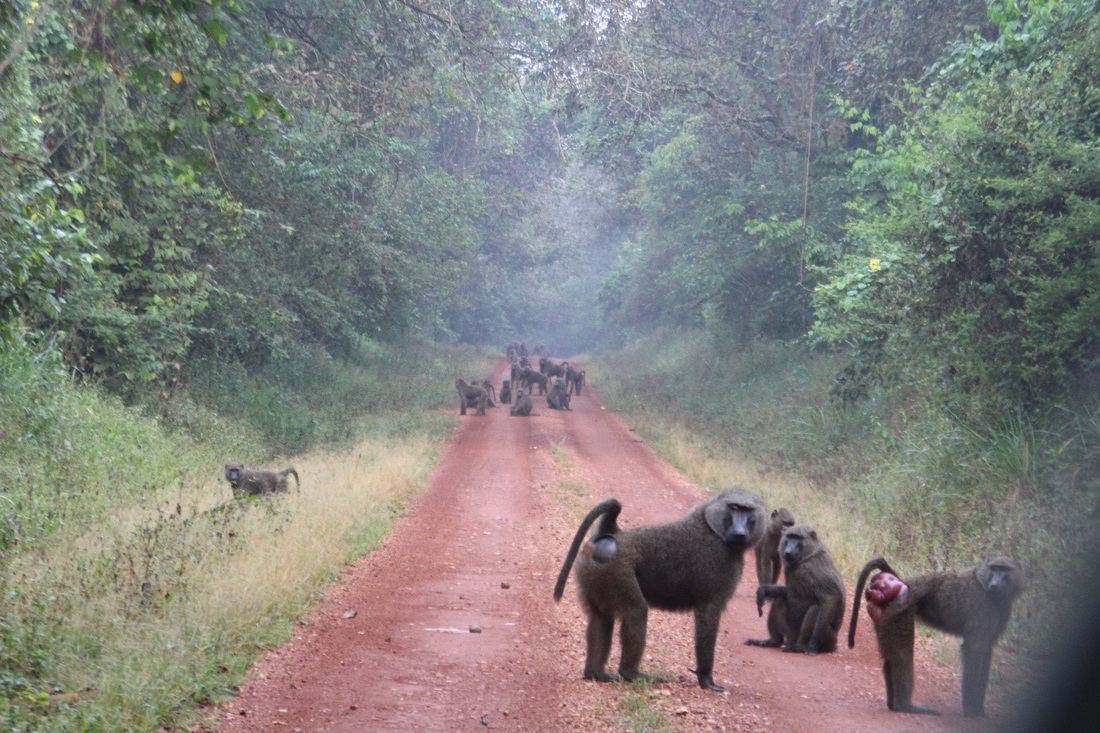
Baboons block our path in the heart of MFNP. The look on the alpha male’s face says it all; “What do you think you are looking at?”
Back on the road, we were just a few minutes from the ferry landing. Once again I was met with more smiles and delight from the band members that I had not seen for some time. One by one, we exchanged pleasantries after which I was asked by Bongomin, the base harp player, if I could join in and play the ‘simba na guruma’ song. Literally translated this song means ‘the lion roars’. With months of no practice away at MSU, I couldn’t seem to find the right note and struggled to keep pace with this expertly-practiced team. Fortunately for me, I was saved by the tenor harp player, Ochaya, who took lead and soon the ferry landing was filled with the joyful sounds of harps and vocals. The ‘simba na guruma’ song was composed by this team on my behalf. Shortly after making friends with the team and chatting about my research, they wrote this song to seamlessly represent the bond that we had formed. The song showers praise upon lions, representing my own fascination with lion ecology, with a chorus that reiterates the phrase ‘simbaaaaaa na gurumaaaa!’ ‘the lionnnnnnn roarrrrrrrrs!’ Hearing this song again transports me back in time to the days when the Snares to Wares initiative first began with biologists and park rangers alike humming this tune as we searched the undergrowth of MFNP for the treacherous snares which threaten the persistence of lions and numerous other species of wildlife in this region.
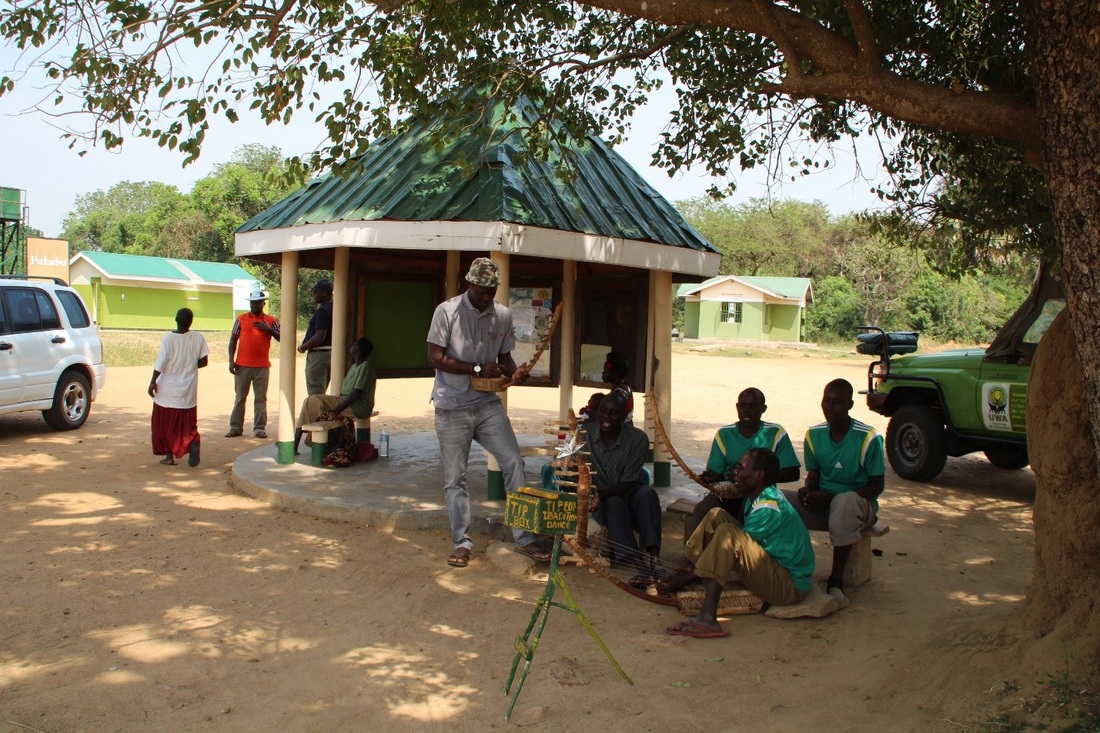
Playing the African harp with the traditional East African music team.
Transfixed by my memories I realized that my anxiety over being rusty in playing the harp was gradually drifting away. I caught up to the pace of the song and found that locals and tourists alike were enjoying the music, bobbing their heads and tapping their feet to the rhythm. With music raging over a 30-minute period though, my reawakened harp playing skills began to fade. I passed the harp over to a more-skilled player and enjoyed the music as an observer. When the ferry was fully-loaded and the tourists gone, the base harp player gave the signal and the band came to a swift and magical stop. With small beads of sweat forming on my forehead and lower arms, I found a large stone in the midst of the band to act as my seat and called on the band to chat about the current state of the Snare to Wares initiative. I learned from the band that the reformed poacher craft group had recently made some additional sales in the market. The carving of wooden craft, I now understand, is more profitable than conversion of wire snares to goods. The band encouraged me to talk to the leader of Craft Boys directly. With the recent and exponential growth in mobile phones in this region, the leader was simply a phone call away. Unlike the days of old when it would take me hours to track him down.
I quickly and eagerly dialed the number and was disappointed to find it unavailable. The team reassured me that the group leader can be found in Pakwach town, 25 kilometers from the ferry landing, and that if the phone is unavailable, it is simply because the phone ran out of charge. With renewed spirits, I thanked the team and headed further north to Pakwach town.
Pakwach is a small town right on the boundary of MFNP at the exact spot the river Nile threads its way into the park. The town has a human population that could comfortably fit into Spartan Stadium on an autumn Saturday. Pakwach is linked to the rest of Uganda via a large road that skirts the northern rim of MFNP and forms a boundary between the park and community. Within sighting distance of the iconic bridge over the Nile leading into Pakwach, I came across a huge African elephant whose presence by the road had stopped the return of village women from a firewood trip inside the park. Elephants rarely cross the bridge into Pakwach town but are a common sight in this part of the park where they hang in the swampy marshes during hot days. The village women kept their distance and I pressed on gently, gliding past this impressive animal.
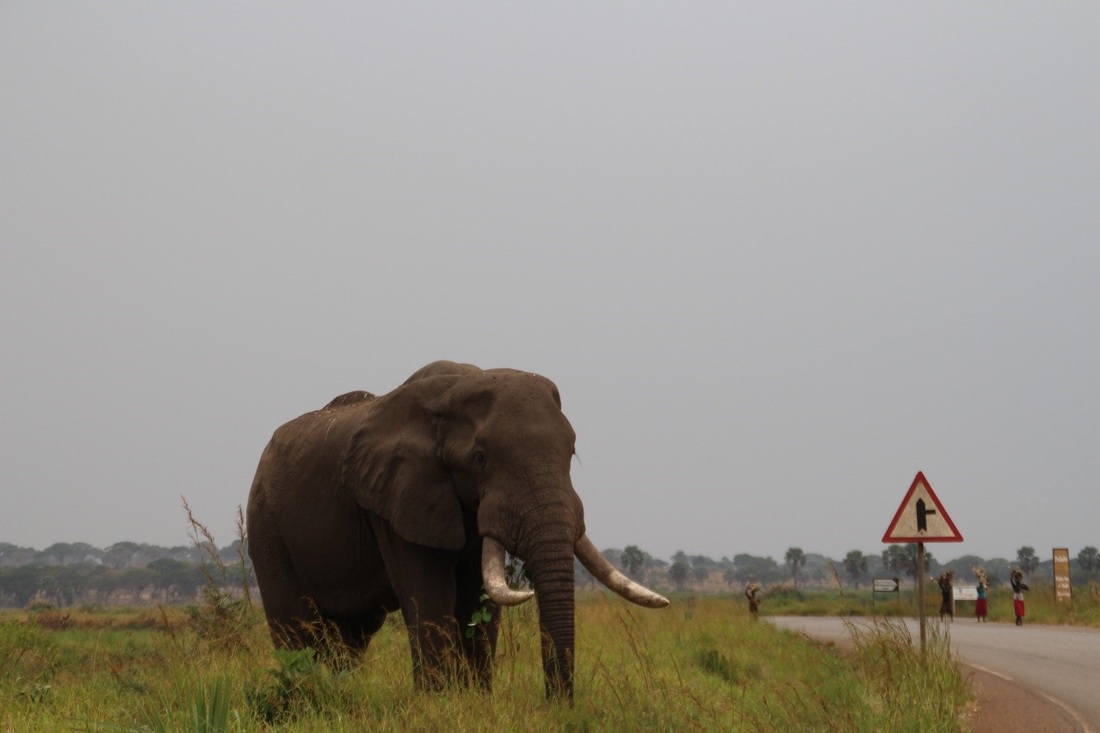
An African elephants stands between local village women and their village.
Once in Pakwach, I headed for the Craft Boys open-air craft workshop and found Robinson –the groups’ leader arched over a used-car tire cutting flip-flop shapes amongst a busy team of youth bent over and absorbed in their work. Dropping his tools, the youthful and energetic Robinson rose and met me half way into the workshop. As he and I embraced I could hear the rustle of the other group members whispering among themselves with older boys explaining to the recent recruits who I was and how I had come to work with them before. The first thing that I did was reiterate my continued interest in working with the team and telling them that I was very happy the team was still maintaining their business. Robinson countered with details of the problems the boys had experienced maintaining the Snares to Wares initiative. The central problem, as I was made to understand, is this: wire crafts primarily only appeal to tourists who appreciate the story of making a craft out of an element of destruction: a snare. But tourists rarely, if ever, visit Pakwach. So there was very little market for these goods in town. Given the lack of a market for the wire snares goods, the Craft Boys had to diversify their trade. This is why they moved into wooden carvings, which are much for appealing to local residents of Pakwach. We talked about what could be done, about how we could make plans to gets these snaring crafts into the park so that they would be more accessible to tourists. I left Robison promising that I would develop some creative solutions to ease these troubles and embolden the initiative once again.
After that meeting, I drove back to my tent site inside the park with mixed feelings. I take joy out of knowing that the Craft Boys are making headway as crafts-makers and earning a living via a diverse business. But I can’t help but be saddened by the fact that we have not yet made the progress that we need to via the Snares to Wares initiative. Without such innovative solutions more wildlife will die in MFNP. I strongly believe these crafts could readily be sold to tourists in MFNP or even in stores throughout the United States and Europe. My resolve now is to link the Craft Boys to all of the local hotel owners and other tourist centers in MFNP. I must find a market for the snare crafts to complete the circle – From Snare to Wares – simultaneously conserving wildlife and preserving human interests. This is the mission statement of the RECaP Laboratory and I accept that banner of responsibility. Tomorrow is a new day and I will keep you posted as to my progress in tracking down the long lost three-legged lion. But for now I will let my eye lids drop.
After that meeting, I drove back to my tent site inside the park with mixed feelings. I take joy out of knowing that the Craft Boys are making headway as crafts-makers and earning a living via a diverse business. But I can’t help but be saddened by the fact that we have not yet made the progress that we need to via the Snares to Wares initiative. Without such innovative solutions more wildlife will die in MFNP. I strongly believe these crafts could readily be sold to tourists in MFNP or even in stores throughout the United States and Europe. My resolve now is to link the Craft Boys to all of the local hotel owners and other tourist centers in MFNP. I must find a market for the snare crafts to complete the circle – From Snare to Wares – simultaneously conserving wildlife and preserving human interests. This is the mission statement of the RECaP Laboratory and I accept that banner of responsibility. Tomorrow is a new day and I will keep you posted as to my progress in tracking down the long lost three-legged lion. But for now I will let my eye lids drop.
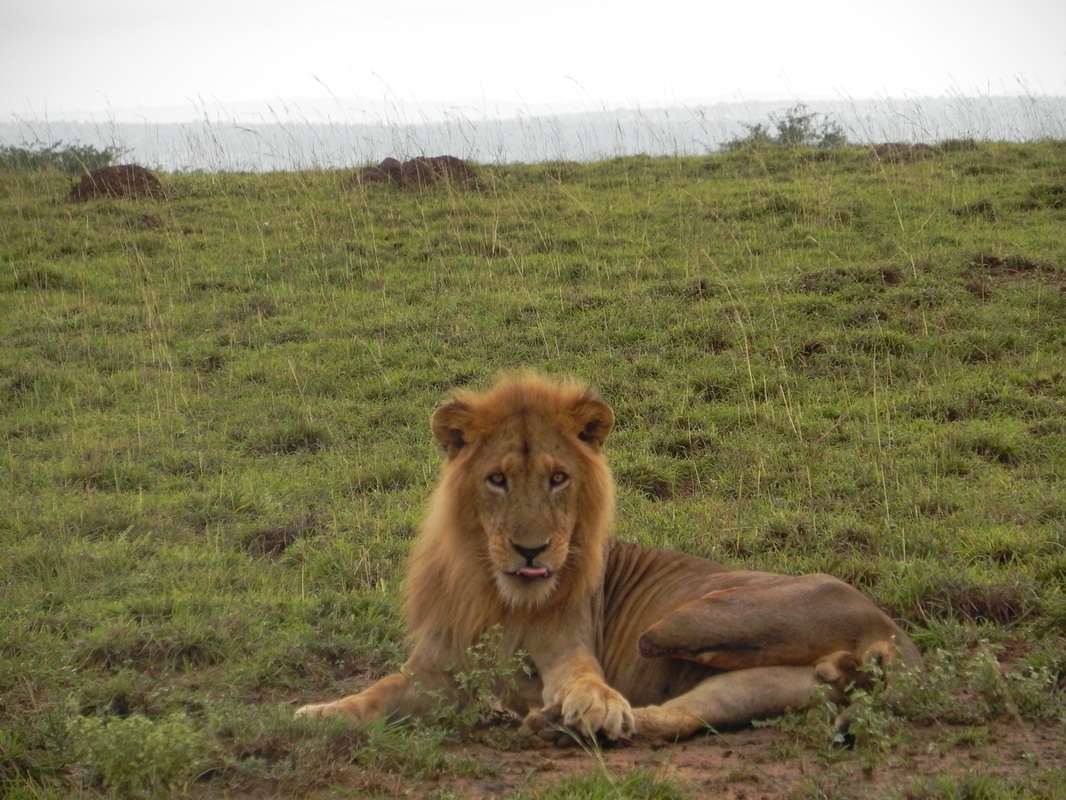
Butcherman: The search begins at dawn.
 RSS Feed