“Will I really fit in? Will I find a place that I can truly belong, and actually be myself?” These were among my greatest worries when crossing the Atlantic on a Delta aircraft headed for Michigan. All I knew of this great land of the free (America) was what I had picked up on from TV shows and pop culture music videos. “Life can be tough out there, you need to quickly make some friends, because you can’t make it alone!” I silently told myself. With no family in the USA I felt like a pioneer. The first in my clan to venture out of the motherland, in the name of graduate education. Armed with the blessings I carried over from Africa, I was ready to set up shop and get to work at Michigan State University furnished by the prestigious MasterCard Foundation Scholarship that I had earned.
Towards the end of the MasterCard Foundation’s orientation week for new scholars, I met Dr. Robert "Bob" Montgomery, my new advisor and mentor, with whom I had only been in touch with previously via email for several months leading up to this point. We clicked instantly, cementing the foundation of the life-long collaboration we had been working on. True to form, we immediately got to discussing several project ideas for my new career in the Research on the Ecology of Carnivores and their Prey (RECaP) Laboratory. I was elated because I love talking ‘science and conservation,’ and this was the first chat I had with someone as informed on current developments in East African wildlife conservation. Bob later invited me to continue the conversation over coffee with his family.
Towards the end of the MasterCard Foundation’s orientation week for new scholars, I met Dr. Robert "Bob" Montgomery, my new advisor and mentor, with whom I had only been in touch with previously via email for several months leading up to this point. We clicked instantly, cementing the foundation of the life-long collaboration we had been working on. True to form, we immediately got to discussing several project ideas for my new career in the Research on the Ecology of Carnivores and their Prey (RECaP) Laboratory. I was elated because I love talking ‘science and conservation,’ and this was the first chat I had with someone as informed on current developments in East African wildlife conservation. Bob later invited me to continue the conversation over coffee with his family.
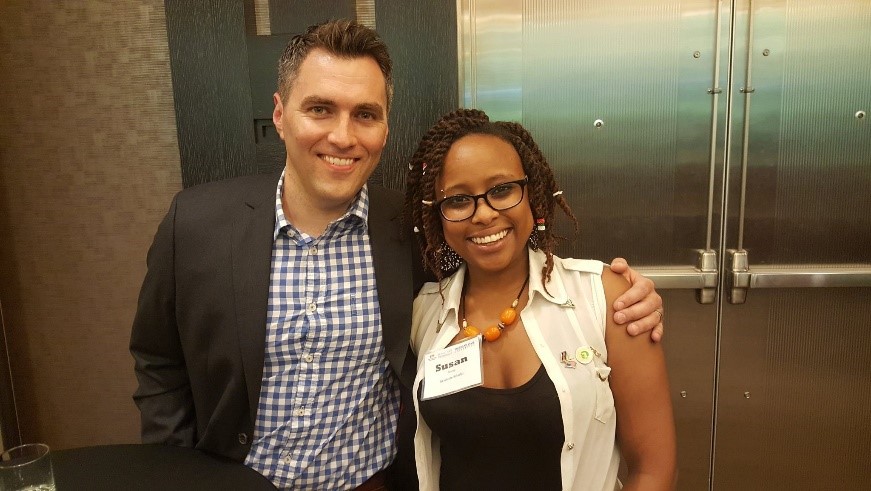
Dr. Montgomery and I meet for the first time at MCF scholars Orientation.
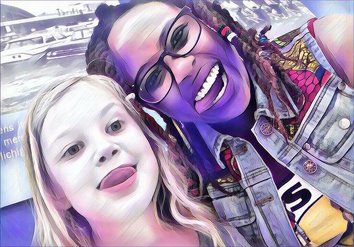 Olly and I, imitating how long the tongues of giraffes can get while feeding.
Bright and early the next day, a cute little blonde girl ran up and gave me a hug at the parking lot by my house. "Hey there beautiful? How are you, my name is Njambi, what is yours?” “I am Olly, and this is my mum Georgina, and my soon to be sister,” she said pointing at her glowing mom, who was expecting their second child. “Haha, that’s amazing, congratulations!” I said extending a hug out to Georgina just before we got into the car. On our way to the coffee shop, the Montgomery’s took me about the city of Lansing so that I could become oriented to my new surroundings. We drove around on a short sight-seeing expedition, somewhat comparable to a wildlife spotting game safari out on the African plains. “Where are all the skyscrapers and thousands of people walking in the streets?” I thought to myself. “If this is the capital of Michigan, shouldn’t it be a lot bigger?” I asked. “Well it is the capital city, but it isn’t a big city…its gets the job done though.” Bob said. Satisfied with the answer, I sat back and came to appreciate the setting that would make up the background of my new life in the states.
Over some hot coffee, croissants, and bonding with my ‘surrogate’ family, I presented them with the small care package I got from home. It consisted of a pack of Kenyan medium roast coffee and an assortment of African trinkets that I got hand-made for them. Best of all was the wooden giraffe carving on wheels that I got for Olly. She absolutely loved it and this got us talking about giraffes, our favorite African animals, and all the fun facts we knew about them. For a five-year old, she was exceedingly smart and knowledgeable, she even taught me a few things that I did not know about flamingos!! She expressed her excitement to join us in the field one day. I too had already started imagining all the fun we would have while out on safari in East Africa. Though miles away from home, I knew I was in the right place, among people with a passion for wildlife similar to mine.
Settling into the lab was a breeze, I quickly became acclimated to my new lab space and familiar with my new colleagues over our first lab meeting of the semester. During this white board session with Dr. Montgomery, we went over our identity, the expectations for our performance, and the core competencies that we should demonstrate in our daily lives and work. ‘RECaPivores’ – as we are collectively known –are collaborative, we are productive, we are competitive, and yet we are very humble. Researchers within our lab exhibit a strong work ethic and are both driven and hungry to be productive. Our system of developing blended student cohorts, by pairing students from Africa with their peers in USA, is a proven way to ensure information sharing, idea generation and the development of innovative solutions to several conservation challenges across the globe.
Through the semester, I have been lucky to get opportunities to represent the lab at some functions and high level gatherings hosted by Michigan State University. As part of a presentation by the lab’s Snares to Wares Initiative , in Novi, Michigan, I got to interact with alumni old and new. They were mostly interested in knowing more about the project’s impact on the wildlife populations saved from deadly snares in Murchison Falls National Park, Uganda. I was extremely proud to share everything I knew especially the fact that through this work we are able to provide some financial support to many poor families by providing an alternative livelihood and source of income. The Snares to Wares Initiative is working to provide alternative livelihood options for individuals so that as opposed to poaching for bush meat, on can become an artisan selling products that are valued by a growing market in America!
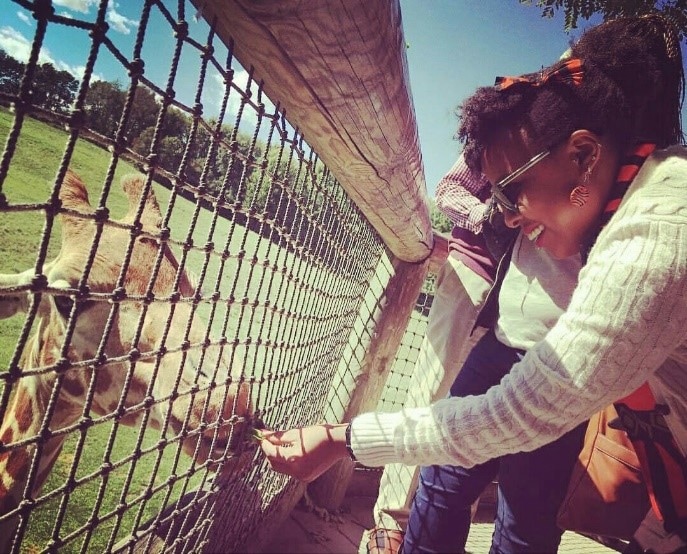
Feeding a giraffe at the Battle Creek Zoo.
Another great initiative that I am looking forward to implementing is a collaboration between Binder Park Zoo, The African Studies Centre at MSU, and the RECaP lab. With our main goal being the promotion of African cultures in tandem with wildlife conservation, we hope to infuse traditional zoo visits with an invigorating curriculum that displays authentic interaction with African cultures. Like many in our field, the administration of this zoo has come to realize that we cannot effectively conserve African wildlife without recognizing the contribution of communities living with it and the cultures that sought to preserve these populations. It was also the first zoo I had been to while in the USA. I must say, it was very impressive. The scale of it was just enormous and the animals in their care had acres upon acres to freely graze and exhibit their natural behaviors. This zoo also did a great job of their simulation of an African village. Binder Park provides an authentic experience of what it’s like while on a wildlife safari, with a tented camp (for overnight stays) and the naming of different zoo sections in my native language, Swahili. Many people never have the opportunity to experience the beauty that African countries have to offer beyond our wildlife, beaches and other natural features. This collaboration may present me with the chance, no matter how small, to provide education opportunities to Binder Park Zoo visitors on what it means to be African and what it takes to conserve African wildlife. In that venue I am hoping to have the opportunity to share my personal experiences growing up with wildlife in Kenya and provide insight into the types of cultures that have been co-created in tandem with wildlife in these regions. I hope that this, where replicable, will instill a new appreciation for the African continent that has long been regarded as
dark
for – a derogatory term representative only of a lack of knowledge of the continent’s people and traditions.
For me the best event of all, was the invitation to Cowles House, the esteemed home of University’s president, Lou Anna Simon. On a chilly Saturday morning, before the biggest football game of the year, we got to talk about our lab’s ongoing projects with the President’s guests over brunch. It was a great chance, to mix and mingle with several top figures within the MSU community. Deans, Associate Deans, professors, prospective donors and friends of MSU were all present. This was a big deal, another great opportunity for the lab to display our amazing work of conservation in action. For me, this was also the perfect chance to describe my research (the application of cutting-edge innovative technology to map spatial patterns in human carnivore conflict) in addition to chatting with individuals who might have interest in supporting our work. We also had the chance to chat, though briefly, with the president and receive her endorsement for the work we do, before she headed out to cheer on the Spartans against Ohio State. Feeling fulfilled, Tutilo and I walked back home, in the first snow of the season, and not even the icy cold could bring down our high spirits.
For me the best event of all, was the invitation to Cowles House, the esteemed home of University’s president, Lou Anna Simon. On a chilly Saturday morning, before the biggest football game of the year, we got to talk about our lab’s ongoing projects with the President’s guests over brunch. It was a great chance, to mix and mingle with several top figures within the MSU community. Deans, Associate Deans, professors, prospective donors and friends of MSU were all present. This was a big deal, another great opportunity for the lab to display our amazing work of conservation in action. For me, this was also the perfect chance to describe my research (the application of cutting-edge innovative technology to map spatial patterns in human carnivore conflict) in addition to chatting with individuals who might have interest in supporting our work. We also had the chance to chat, though briefly, with the president and receive her endorsement for the work we do, before she headed out to cheer on the Spartans against Ohio State. Feeling fulfilled, Tutilo and I walked back home, in the first snow of the season, and not even the icy cold could bring down our high spirits.
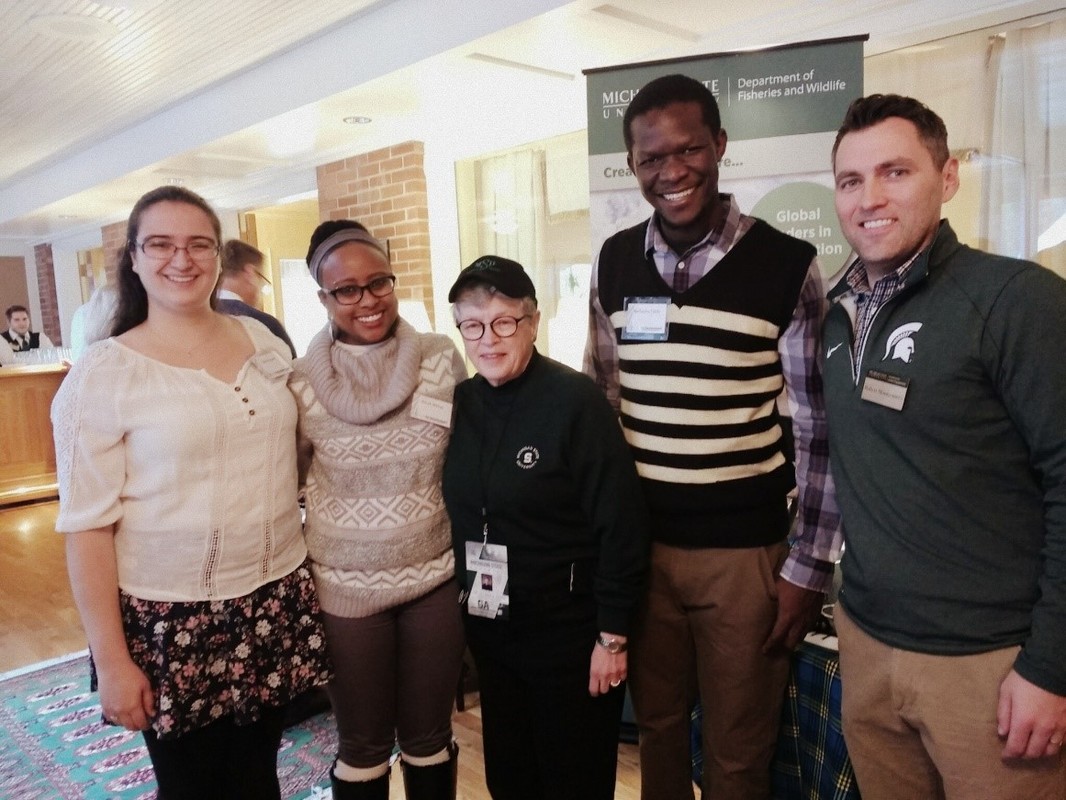
From Left: Clara, Susan, Lou-Anna Simon (MSU President), Tutilo, Dr. Montgomery.
It’s now finals week, and soon after everybody will be on their way to enjoy their winter break. As I reflect back on my progress on settling and fitting in with the lab, I am nothing but content and proud of myself. I have found a family, and made life-long friends among my lab mates. Nothing can stop me now in achieving my dreams of making a difference in conservation and leadership in my field. I am already eager to get on with my second semester, I am so ready for more of that RECaP magic!
 RSS Feed