It is day 3 since my return to Murchison Falls National Park (MFNP). The jet lag has worn off. I am settling back into my field research routine. And I have become reacquainted with most of my friends again, though everyday there are still one or two handshakes that are particularly warm given extended time apart. But, the question everybody asks when I see them is ‘have you found Butcherman yet?’ Butcherman is an extremely famous lion in Uganda. He is a beautiful large-maned individual who fought for his position and became the alpha male of the Delta Pride – which dominates extremely productive habitat in the northern part of MFNP along the Victoria Nile River Delta – in 2009. But Butcherman’s story is not simply one of hierarchy and dominance. No, Butcherman’s is a story of savagery, redemption, and mystery. You see, the habitat in the Delta Pride is not only productive because of proximity to water (water brings primary production, primary production brings ungulates, ungulates support lions), it is also dangerous for the same reason. Poachers tend to access this park via the waterways, where they come on shore and walk inland planting wire snares along the way.
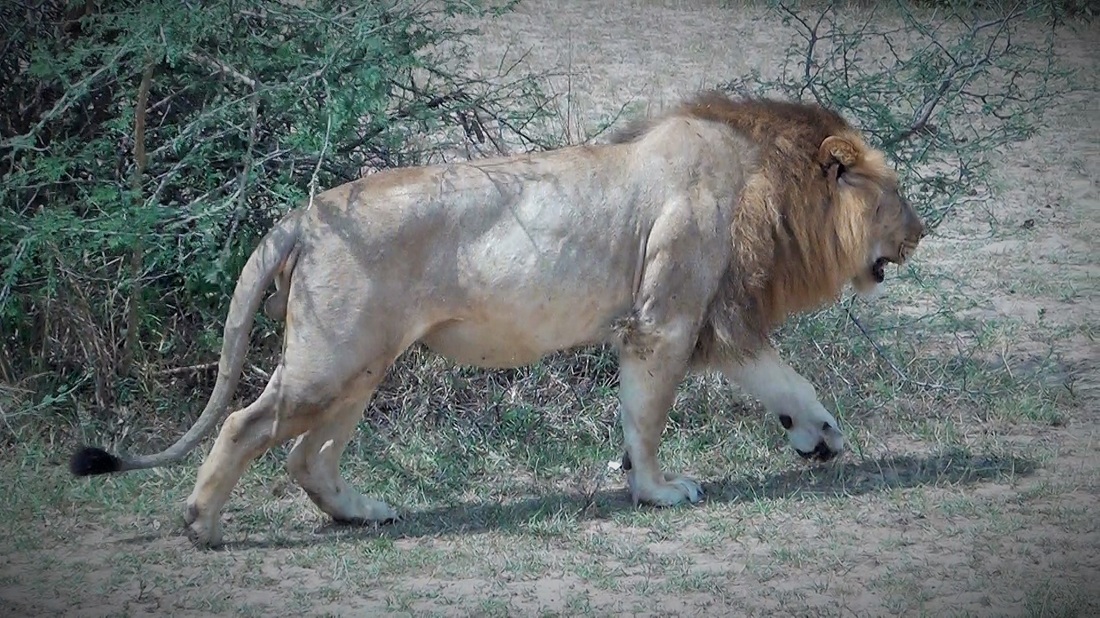
Butcherman was an alpha male for just 7 months when his rear left foot made a fateful and inadvertent step into a poacher’s snare. Wire snares are unfortunately widely used in this region for bush meat (mainly hartebeest, waterbuck, or kob) but are indiscriminate weapons that are just as capable of capturing an ungulate as they are an elephant. I was part of the team that helped to free Butcherman from this snare all those years ago. When we found him he was exhausted from his hours-long effort of trying to get clear of the leg hold. The snare constricted so tightly around his leg that it shut off all blood supply causing the tissue to become necrotic. We had to amputate Butcherman’s entire lower leg, from the knee down. I remember clearly thinking at that moment that Butcherman’s days as an alpha were done. It would not be possible for a 3-legged lion to defend his alpha male status. Or would it?
Though Butcherman was licking his wounds, he returned to the safety and comfort of his Delta Pride where he was looked after by both the pride females and a beta male named Bernie. Butcherman made a relatively swift recovery, but had great difficulty moving as he hobbled along through his territory. What became clear was that he was completely unable to hunt preferred lion prey (medium to large ungulates) independently. But the skill that Butcherman fell back on was his cleverness. He knew that his roar, his mane, and his capability for intimidation were not affected by his leg. In this way he mated, reared, and ruled over the Delta Pride for an unbelievable 3 additional years. Now this story brings us almost to the present when just 3 months ago Butcherman was overthrown by two rival males (Ricky and Raphael) and vanished into thin air.
Dr. Robert (Bob) Montgomery, both the director of RECaP and my graduate advisor, has traveled half way around the world to join in the search for Butcherman. We are interested in understanding exactly how snaring effects the ecology of lions. We are pursuing questions such as; What proportion of the MFNP lion population is affected by snares? How does snaring cause change alpha male tenure? What are the effects of snaring on the ability of lions to survive and reproduce?
Today, Bob and I drove out of our remote camp site at day break heading southwest. Our plan was to visit the core range area of the Delta pride first, then work our way outwards in a sweeping and ever-increasing circle. At over 200 km2, the Delta Pride home range is vast and comprised of a mix of expansive open savannahs dotted with thicketed acacia bushes. The western edge of the pride range is the Albert Nile which also marks the northwestern part of the park edge lined with swamp marshes where prehistoric looking shoe-bill storks reside. The sky is lit in golden strands, an oribi (a small antelope) races across the road drawing our attention. We briefly stop to investigate the cause of alarm but see nothing interesting. Without exchanging words about this, I gently ease my foot off the clutch pedal and guide the land cruiser off the road and along the ridge on high ground. If we are going to find Butcherman, we are going to use every trick in our basket.
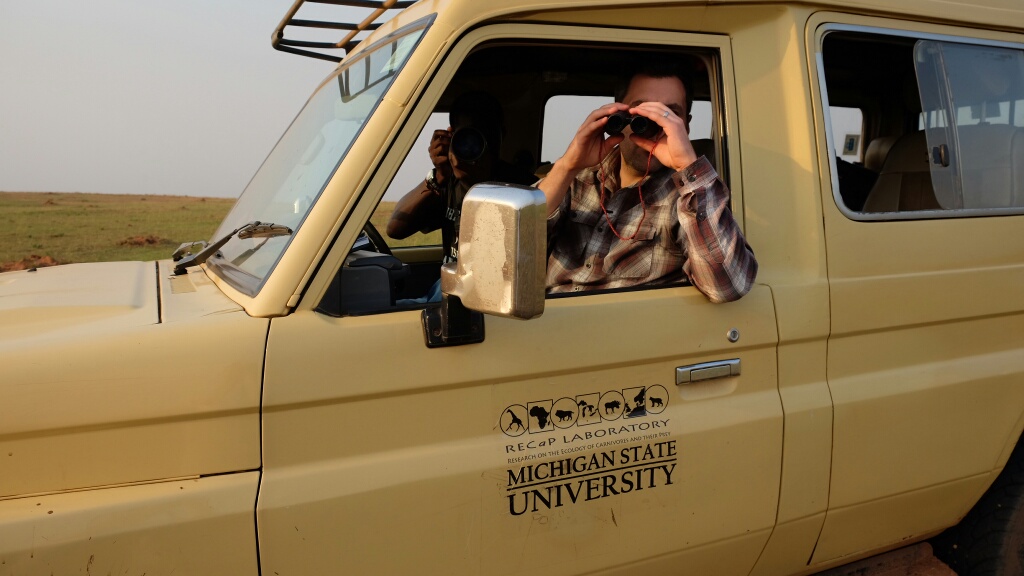
Tutilo and Bob searching for Butcherman in the RECaP truck.
Buffalos, waterbucks, kobs, reedbuck, and hartebeest are feeding on the moist shoots of freshly burnt fields. Elephants in groups, are browsing on short acacia trees. Beautiful views drape our perspective in every direction which eases the tensions on our mind, somewhat. Where can Butcherman be? And then… we pick up a guttural sound quite a ways off in the distance. The sound is distorted by the local din of birds squabbling over breakfast. But the sound is unrecognizable. A male lion. A lion’s roar is something that you not only hear, but you feel. When the sound of a lion’s roar echoes across the savannah the sound waves meet your body thundering through your core, emanating from your stomach up until it reverberates in your heart. Once experienced – it is always with you. The experience of a lion’s roar cannot be undone. This could be it, I thought, let this be Butcherman! From the depth of the roar, I could tell that the lion was at least 3 miles in the general direction of Pakuba airstrip, a small flat piece of land several kilometers from the Delta Pride where planes bring tourists into the park. Unfortunately, a direct path to the sound was blocked by an impassably-steep dried-up river bed. Our distance to the point would now double and our tension would do the same. As we drew closer to the airstrip I kept thinking to myself “This is going to be it.”
Pakuba airstrip is a marram surface 1.5 km long runway with service housing on its side. The entire infrastructure is protected by an electric fence to keep wildlife out. The area around Pakuba airstrip has got open fields with few trees and occasionally a young borassus palm thicket. With the kob whistling and displaying forward vigilance behavior, we were almost certain in which borassus bush concealed this lion. As we drew near, we held our breath. When I positioned the RECaP truck into full view of the lion, it became clear that this was not Butcherman but another male lion. This lion had all the four limbs and a much darker mane. With large exhales, we re-grouped. A couple of snaps of the animal’s whisker pattern to identify him (we will compare the image with a booklet of identities of lion in this system) and we were off.
Pakuba airstrip is a marram surface 1.5 km long runway with service housing on its side. The entire infrastructure is protected by an electric fence to keep wildlife out. The area around Pakuba airstrip has got open fields with few trees and occasionally a young borassus palm thicket. With the kob whistling and displaying forward vigilance behavior, we were almost certain in which borassus bush concealed this lion. As we drew near, we held our breath. When I positioned the RECaP truck into full view of the lion, it became clear that this was not Butcherman but another male lion. This lion had all the four limbs and a much darker mane. With large exhales, we re-grouped. A couple of snaps of the animal’s whisker pattern to identify him (we will compare the image with a booklet of identities of lion in this system) and we were off.
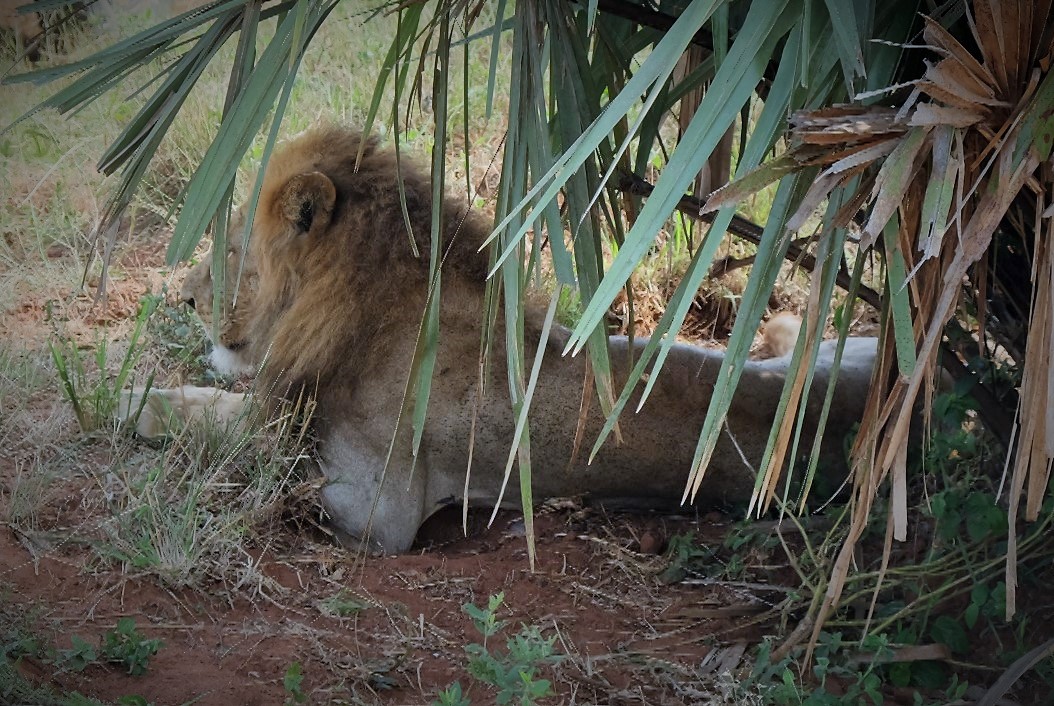
We found the roaring male. Unfortunately, it is not Butcherman.
We continued heading westwards along the Victoria track towards the delta. We should check out the hippo pool, the land that legendary Butcherman formerly stalked, I thought. With the sun beating down upon us we had a quick field lunch of roasted ‘jungu’ (Swahili for peanut) washed down with pineapple juice as we watched a school of hippos yawn and play. I found it difficult to hide my disappointment from Bob. I got the distinct impression that he felt much the same. Not even the presence of an incredibly-large buffalo herd with mamas nursing their young could raise my spirits. The delta region lies at the lowest part of MFNP right in the north most tip of western arm of the rift valley. Working here for many years has taught me to find lions quickly as the place gets unbearably hot even during mid-morning when lions disappear into thickets to avoid the heat. It was approaching 10 am and I knew that within 30 minutes our chances of finding lions would plummet, dampening my burning desire to find Butcherman today.
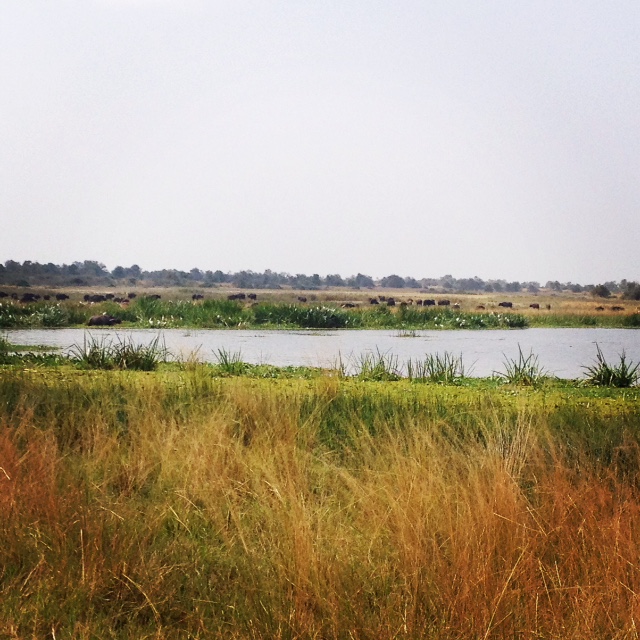
The hippo pool which is an extremely productive habitat for the Delta Pride lions, but also a risky one given increases in snaring along the shore.
My thoughts were broken by the encouraging voice of Bob, ‘Alright, where should we go now bwana (Swahili word for sir)?’ I responded by sliding into the driver’s seat and driving off along the Nile river track. Where could Butcherman be?! Ten minutes of silent driving and a thought struck me. We should try a series of thickets near a water pool just north of the delta. This is an area that the pride females like using for the cover that it affords their young. Once we got past the delta point sign post on the western-most tip of MFNP, I instinctively slowed and we began our search looking under the bushes on either side of the car. Look for the dark shade, then look for a lion shape…look for the dark shade, then look for a lion shape. It became our mantra.
Then suddenly Bob said, “Here we go.” Directly off the left-hand side of the car just 20 feet from our position was a huge male panting heavily in the cooling shade of a large bush. The mane looked like Butcherman, but we couldn’t yet see his legs. I repositioned the vehicle so that the animal revealed more of himself. The mane looked dark. Like a rock falling through water, a sensation went through my gut. This wasn’t Butcherman. Not only was it not Butcherman, but I strongly suspected that it might be the exact lion that displaced him from the Delta pride leadership. Before making my pronouncement I asked Bob to tell me what this animal’s hind legs looked like. Bob said, “This one is missing all of the toes on one of his hind feet.” Damn, I was right after all. This was Raphael who, along with his brother Ricki, knocked Butcherman off of his pedestal.
Then suddenly Bob said, “Here we go.” Directly off the left-hand side of the car just 20 feet from our position was a huge male panting heavily in the cooling shade of a large bush. The mane looked like Butcherman, but we couldn’t yet see his legs. I repositioned the vehicle so that the animal revealed more of himself. The mane looked dark. Like a rock falling through water, a sensation went through my gut. This wasn’t Butcherman. Not only was it not Butcherman, but I strongly suspected that it might be the exact lion that displaced him from the Delta pride leadership. Before making my pronouncement I asked Bob to tell me what this animal’s hind legs looked like. Bob said, “This one is missing all of the toes on one of his hind feet.” Damn, I was right after all. This was Raphael who, along with his brother Ricki, knocked Butcherman off of his pedestal.
Raphael, the new alpha of the Delta Pride and the lion that displaced Butcherman. Note the snaring damage on the hind leg. All toes are gone.
We watched Raphael, gutted about the myriad of events unfolding. A short while later, with the shade fast-receding, Raphael lifted his head off the ground and glanced across the empty patch at the bushes a short distance away. Reading lion behavior this motion tells you exactly where other pride members are located. Without further notice Raphael, keen to reacquaint with his pride-mates, got off the ground traveling in the exact direction that he was glancing. Less then 100 meters away concealed in an extremely dense bush we saw Ricki. I know these lions well. The brothers were only 2-week old cubs when I first met them 4 years ago when I was collar-tracking their mother Pamela.
After some more observation and the sun now firmly above our heads, I accepted the fate that today was not the day that we were going to find Butcherman. I slowly drove us back to our camp site with a flood of questions still lingering my mind. What happened when Butcherman was toppled by these brothers? Was it a fatal takeover of the delta pride? If not, then how could he find food in exile? One thing that I am sure of is that the search for Butcherman is far from over. We will be widening the search to include parts of the park that I know to be out of current pride ranges. These would be the safest places for Butcherman to live in exile. Though I desperately want to find this male that I have known for the entirety of my professional career, I am beginning to think that we might only find the ghost of the 3-legged lion of Uganda that once reigned over the Delta Pride. But until we determine that for sure, the search continues.
After some more observation and the sun now firmly above our heads, I accepted the fate that today was not the day that we were going to find Butcherman. I slowly drove us back to our camp site with a flood of questions still lingering my mind. What happened when Butcherman was toppled by these brothers? Was it a fatal takeover of the delta pride? If not, then how could he find food in exile? One thing that I am sure of is that the search for Butcherman is far from over. We will be widening the search to include parts of the park that I know to be out of current pride ranges. These would be the safest places for Butcherman to live in exile. Though I desperately want to find this male that I have known for the entirety of my professional career, I am beginning to think that we might only find the ghost of the 3-legged lion of Uganda that once reigned over the Delta Pride. But until we determine that for sure, the search continues.
 RSS Feed