Well, it's early May, which is an exciting time for research laboratories in Fisheries and Wildlife (FW) and many other departments here at Michigan State. Field season is here! Most FW graduate students are already in the field or in the midst of making final preparations for that field work. And during such field seasons students collect substantial amounts of data between now and the start of school in late August. These data collection efforts involve hours spent securing research permits, preparing field equipment, and establishing all data collection protocols. Making the transition from classrooms to the field can be challenging, as students have become adapted to hours in office chairs with minds conditioned to final exams and research papers. These responsibilities can be further masked by the sights, smells, and sounds (or really, lack thereof) on our beautiful campus in early summer. Not to mention the Pavlovian deterrence of most graduate students developed from previous hardships experienced during fieldwork.
It's debatable whether the actual work in the field or the necessary preparation for field work is more draining. But I think many will agree that no matter how severe a poison ivy rash or how many tsetse fly bites you get, you'd rather be scratching them in the field than when dealing with the prerequisite logistics. Luckily here in RECaP, my fellow students are ahead of the game. Tutilo Mudumba is currently joined by our PI (Bob Montgomery) and new research assistant Sophia Jingo in Murchison Falls National Park, where they are setting things up for his field work focusing on lion conservation, and kicking off the Snares to Wares Initiative . Steve Gray is getting ready to again conquer the hoary frosts of Northern Michigan until and beyond when that frost no longer comes. Last year, Steve made it through a very mentally exhausting field season – I think he’s due for some better fortune this time around. I know Arthur Muneza must be feeling some serious relaxation, as he doesn't have the same load of field work, but has just successfully defended his master's thesis. However, given that he is starting his Ph.D. this January, field work is right around the corner for him. Remington Moll and Waldemar Ortiz have been busy preparing and communicating with personnel at the Cleveland Metroparks, eagerly awaiting another field season in which they will set up even more camera traps throughout the Emerald Necklace this summer. As for me, I couldn't be more excited for my first field season in my new "field" - the RECaP offices.
It's debatable whether the actual work in the field or the necessary preparation for field work is more draining. But I think many will agree that no matter how severe a poison ivy rash or how many tsetse fly bites you get, you'd rather be scratching them in the field than when dealing with the prerequisite logistics. Luckily here in RECaP, my fellow students are ahead of the game. Tutilo Mudumba is currently joined by our PI (Bob Montgomery) and new research assistant Sophia Jingo in Murchison Falls National Park, where they are setting things up for his field work focusing on lion conservation, and kicking off the Snares to Wares Initiative . Steve Gray is getting ready to again conquer the hoary frosts of Northern Michigan until and beyond when that frost no longer comes. Last year, Steve made it through a very mentally exhausting field season – I think he’s due for some better fortune this time around. I know Arthur Muneza must be feeling some serious relaxation, as he doesn't have the same load of field work, but has just successfully defended his master's thesis. However, given that he is starting his Ph.D. this January, field work is right around the corner for him. Remington Moll and Waldemar Ortiz have been busy preparing and communicating with personnel at the Cleveland Metroparks, eagerly awaiting another field season in which they will set up even more camera traps throughout the Emerald Necklace this summer. As for me, I couldn't be more excited for my first field season in my new "field" - the RECaP offices.
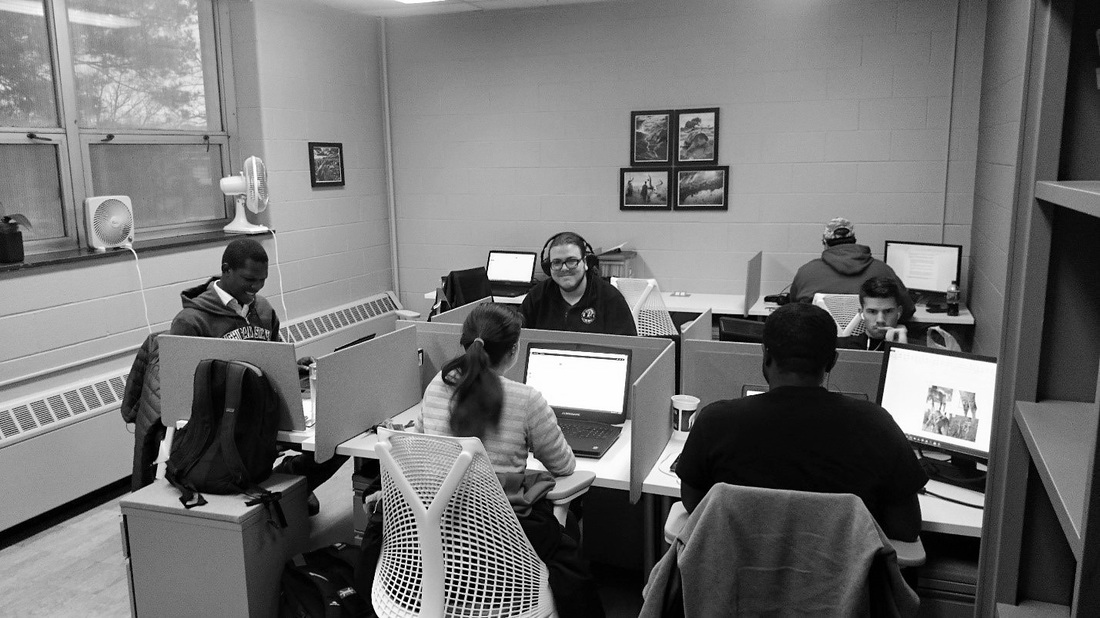
One of the new RECaP offices, picturing lab members who have since transitioned to a life of field work.
Alright, I
have
been working here since August, and my research as an aspiring quantitative ecologist is generally independent of seasonality (you could say certain aspects are slightly
correlated
… but then you'd be me, dropping statistical puns – you are forewarned). Nevertheless, it
is
my first summer since 2011 that will not revolve around data collection in Michigan forests, and I am quite geeked about this transition! For one, the field of quantitative ecology is a relatively new discipline blending principles from computer science, mathematics, statistics, and ecology. Of course, ecologists have relied on the fruits of these disciplines for decades now, but the ubiquity of cheap computing power has led to a revolution that enabled a myriad of new techniques for collecting, manipulating, and analyzing all sorts of data. These fundamental changes in the ways we observe and study ecological systems have resulted in a shortage of ecologists who are technically trained to actually use many of these techniques. There are gaps between the quantitative methods available and what is feasible for ecologists to implement in their research. The application of these techniques for ecological problems requires researchers who have a balance of quantitative technical knowledge as well as familiarity with ecological theory and an appreciation for the idiosyncrasies of ecological data.
My work here in RECaP is characterized by two broad roles; that of i) quantitative ecologist and ii) statistician. As a quantitative ecologist I help investigate questions that require sophisticated quantitative methods or custom programing to assess. In this capacity I can apply my skills in a variety of ways, from assisting a colleague with modeling expertise for a component of their overall research project, to pursuing my own projects! In both scenarios, it is often the case that I will work with data that has already been collected. For example, in my current project I am part of a large team interested in exploring the relationship between moose movement and ambient temperature. This general idea is of interest because many have suggested that rising ambient temperatures associated with global climate change threaten the conservation of moose. Along with colleagues at the Norwegian institute for nature Research we are trying to determine whether there is any evidence of heat influencing moose movement, with implications for their survivability.
My work here in RECaP is characterized by two broad roles; that of i) quantitative ecologist and ii) statistician. As a quantitative ecologist I help investigate questions that require sophisticated quantitative methods or custom programing to assess. In this capacity I can apply my skills in a variety of ways, from assisting a colleague with modeling expertise for a component of their overall research project, to pursuing my own projects! In both scenarios, it is often the case that I will work with data that has already been collected. For example, in my current project I am part of a large team interested in exploring the relationship between moose movement and ambient temperature. This general idea is of interest because many have suggested that rising ambient temperatures associated with global climate change threaten the conservation of moose. Along with colleagues at the Norwegian institute for nature Research we are trying to determine whether there is any evidence of heat influencing moose movement, with implications for their survivability.
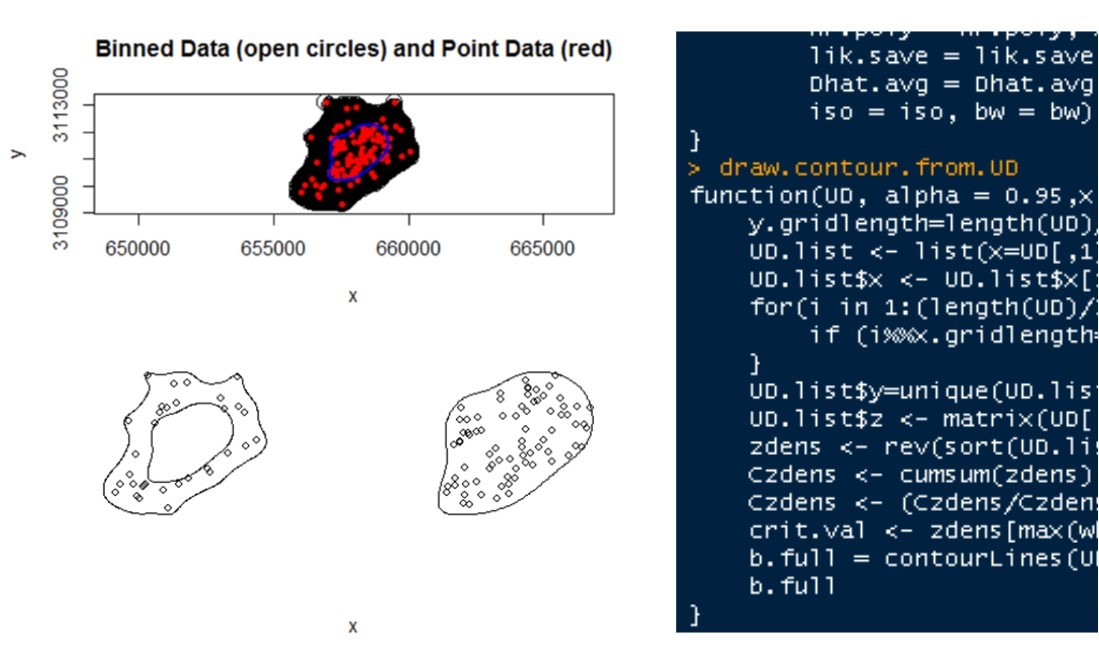
An example of how I can help with the analysis portion of study. This involved combining source code from two different software packages to analyze the core area utilization of mallards in the Midwest.
Progress in science is a community effort, and when confronted with challenging questions, researchers are often eager to collaborate. In my opinion, this is really one of the most beautiful aspects of the field I’ve entered – data-sharing! This drive to share resources is further intensified by the growing abundance of sophisticated data-collection technologies. From GPS collars that record auxiliary information (like
heart rate
) to nationwide sensor networks like the National Ecological Observatory Network (
NEON
), many projects are generating TONS of information to use in models that describe complex systems. However, there are only so many analyses that can be feasibly performed by a research group in a given amount of time, given methodological limits. In other words, we’re up to our eyeballs in data, and there are many other ways to analyze existing datasets; so many different questions that can be explored! Enter the quantitative ecologist, with the ecological background necessary to explore important questions along with the technical knowledge for selecting and applying the best tools for the job.
The other role I am hoping to play is more akin to the idea of an ecological statistician. As important as furthering ecological theory is the development and testing of the techniques that are used to do so, and there is progress to be me made in expanding our analytical toolboxes to handle such fundamentally different data types and volumes. The age of big-data in ecology is here, and like so many other disciplines, research involving statistical methods in ecology has become highly diversified.
To translate progress to practice, innovation in design of new analytical methods also requires innovation in implementation of these methods. Open-source statistical software platforms such as R have become the norm for doing so. This is because they are completely FREE! Free in two senses: free as in it does not cost any money to download and use the software; and free as is anyone can access, manipulate, and redistribute the source code. Thus, many of the contributions I hope to make will involve design and documentation of the actual software tools ecologists can use to analyze data. This idea – that I can create packages to be used by researchers in their own projects – is perhaps what I am most excited about.
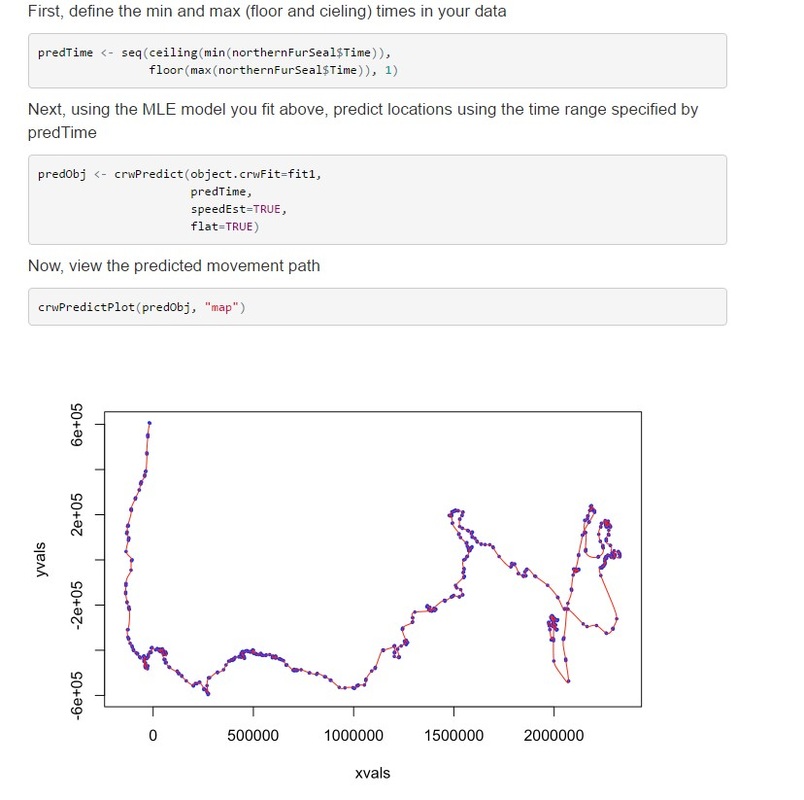
A crucial component of providing new software for ecologists to use is creation of companion documents to demonstrate its implementation. This is an example of a vignette, or brief demonstration of use, for the R package “crawl” used to model movement paths of telemetry-tracked animals.
Whether it be exploring new questions in applied ecology, modification of some existing method, development of a new method, or creation of a novel software package, my time spent conducting traditional field studies will likely be minimal, at least in the near future. I find this funny, as I didn’t get into ecological research five years ago because I loved the challenge of programming and mathematics. I was just a kid that said, “What? I can actually get paid to conduct research in some of the most beautiful areas of Michigan? Where do I sign?” I was then off to a good start to pursue one of my truest passions: to be part of the global community working to manage and conserve our natural systems despite immense anthropogenic influence. But in discovering my strengths and weaknesses as an undergraduate, I realized I might have my greatest impact if I can use my quantitative skills to make new methodologies accessible to researchers. I have found my home here at RECaP where I can pursue this goal, trading in my outdoor work for an office and a machine. Together (and with the aid of my trusty Dell monitor!), they act as a portal into the vast reaches of cyberspace that harbor research journal and textbook databases, Q&A forums, blogs, software repositories, and virtually all other sources of information needed to achieve my research objectives. i.e., my new field sites.
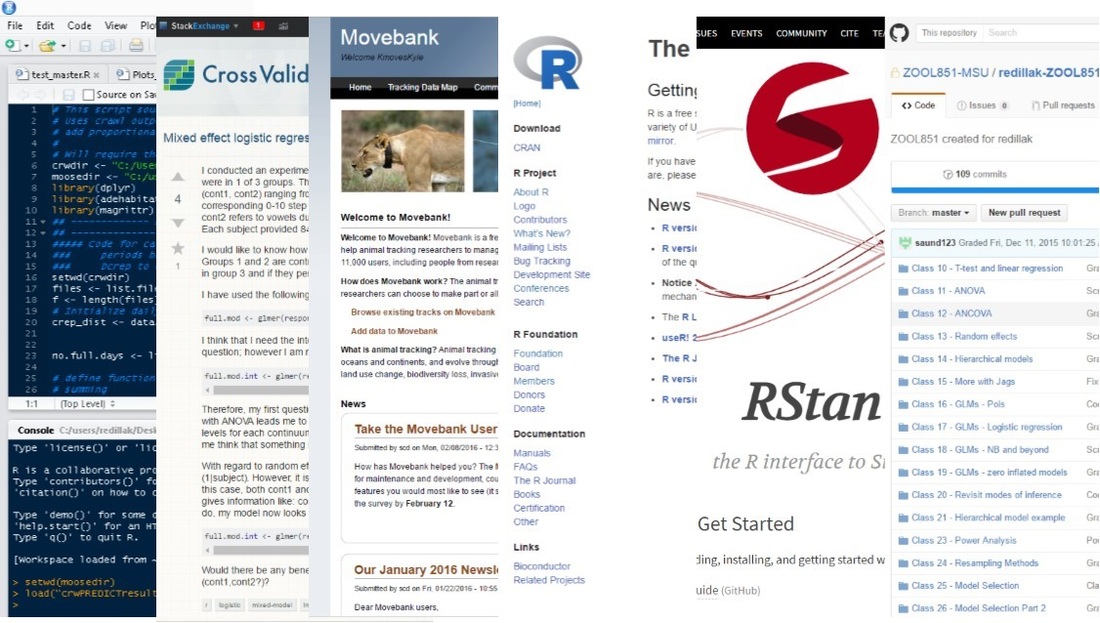
Some of my “field sites” I’m regularly visiting during a typical day’s work.
 RSS Feed